Different Inverter Topologies in UPS System
June 09,2026


Abstract
UPS products boast over 50 years of design and manufacturing history. Driven by continuous advances in fundamental science, the industry is exploring cutting-edge technical solutions to accommodate increasingly complex application scenarios while guaranteeing operational reliability of UPS equipment. This article elaborates on existing UPS inverter technologies and conducts an in-depth comparative analysis of their technical discrepancies.
1. Two-level Inverter & Three-Level Inverter
Two-level topology represents the most traditional design for high-frequency UPS. Its topology delivers only two output voltage levels: +Vdc (positive DC-link voltage) and −Vdc (negative DC-link voltage), with the output current taking the form of square-wave approximated sine wave. Rapid switching between the two voltage levels inevitably introduces notable harmonic distortion in output waveforms. To facilitate practical deployment of this topology within UPS circuits, an additional filter system is generally installed at the output.
If add a neutral zero-level between +Vdc and −Vdc, the topology is upgraded to output three voltage levels: +Vdc/2, 0 and −Vdc/2, which is defined the three-level topology technology.
2. Comparison between Three-level Inverter and Two-level Inverter Technologies
Three-level topology delivers superior output performance indicators compared with two-level topology:
2.1 Lower output THD: Benefiting from an extra voltage level, three-level topology generates output voltage waveforms much similar to ideal sine waves, resulting in reduced THD and improved output power quality.
2.2 Reduced Electromagnetic interference (EMI): Rapid voltage variation during IGBT turn-on and turn-off generates abundant high-frequency harmonics and severe EMI. Three-level topology features a lower voltage change rate (dv/dt) than two-level, which effectively cutting down EMI.
2.3 Higher efficiency: Although three-level topology has higher conduction loss, its switching loss is substantially lower than that of two-level topology. The overall power loss of three-level topology is hence lower, enabling higher operational efficiency.
3. Types of Three-Level Inverter Topologies
Three-level inverter topologies adopted in UPS equipment fall into two categories: I-Type (NPC) three-level topology and T-type three-level topology.

Figure 1: I-Type (NPC) Three-Level Inverter Topology
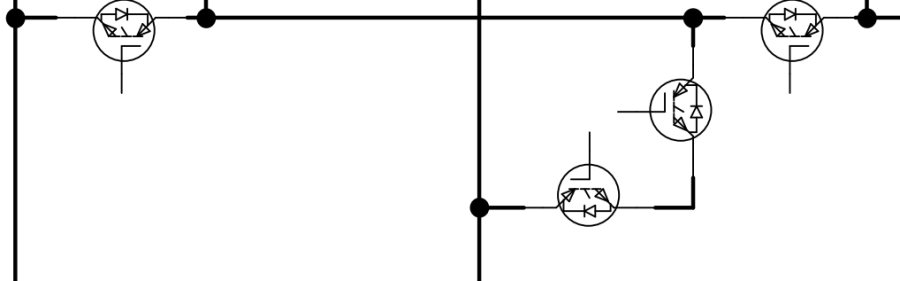
Figure 2: T-Type (NPC) Three-Level Inverter Topology
3.1 Comparative Analysis of the Two Topology
The maximum withstand voltage of power switches in I-Type topology is 1Vbus, with four IGBTs each rated at 1Vbus inside the circuit. For Ttype topology, switches Q1 and Q4 withstand a maximum voltage of 2Vbus, while Q2 and Q3 are rated at 1Vbus.
Compared with T-type three-level, I-Type topology requires two extra clamping diodes to realize three-level voltage output.
In terms of component cost, T-type three-level topology comes at a slightly higher component cost than Type-I counterpart.
3.2 Topology Efficiency
Topology losses of UPS mainly consist of IGBT switching loss, conduction loss and losses from other components, with device losses accounting for approximately 80%~90% of total loss. The T-type three-level topology features higher switching loss than the Type-I three-level counterpart, but its conduction loss is considerably lower. Overall, the T-type three-level topology achieves lower total power loss and superior topology efficiency.
3.3 Service Life Comparison
Thanks to higher efficiency of T-type three-level topology, its components operate at lower case and junction temperatures compared with those of TypeI topology, which extends component service life. Furthermore, the T-type configuration eliminates clamping diodes, features simpler overall control algorithms and fewer potential fault points. Accordingly, UPS equipped with T-type three-level circuits delivers longer service life.
3.4 Comprehensive Analysis
In terms of upfront capital expenditure, the I-Type three-level topology entails lower CAPEX than the T-type alternative. Nevertheless, when OPEX is taken into account, the T-type solution has higher efficiency, longer service life and reduced maintenance expenses, leading to markedly lower operational expenditure. The total cost of ownership (TCO) of the two different topologies breaks even in approximately three years. Once the service period exceeds three years, the TCO of T-type three-level becomes lower than that of I-Type. Given the designed service life of UPS exceeds 10 years, T-type three-level topology stands will be more suitable in the design of UPS system.
4. Other Technologies
Apart from the three-level topologies discussed above, there also exists four-level inverter technology. Compared with three-level solutions, four-level topology further reduces device stress on legs. However, it delivers only little efficiency improvement against T-type three-level topology. In addition, the increased quantity of components pushes its total cost up by 30%–40% and results in a higher overall TCO. For these reasons, four-level topology has not been widely deployed across the UPS industry.
Conclusion
With continuous technological advancement, modern UPS design prioritizes both reliability and total cost of ownership (TCO). Three-level topologies, especially the T-type three-level topology, will become the preferred route for future product development. Gradually replacing conventional two-level technology, it will be deployed on an expanding range of UPS products.

Kstar Group
Kstar New Energy
 login
login